Within the high-stakes world of today's serious drifting, victory is not merely solely a function of sheer horsepower or driver bravado. Rather, it is now a complex engineering challenge that necessitates a painstaking fusion of selecting a inherently capable vehicle platform, arming it with the correct drift-spec components, and, most critically, understanding its dynamic behavior on the course through sophisticated vehicle dynamics analysis tools. This comprehensive handbook will serve as your roadmap starting from the initial idea of a competition vehicle all the way to the final telemetry-optimized adjustments that turn a strong car into a predictable champion. We will examine in detail the art and science of vehicle alignment optimization, illustrating how a state-of-the-art suspension tuning tool like a dedicated telemetry system eliminates guesswork and provides unmatched insight into your car's actual performance.
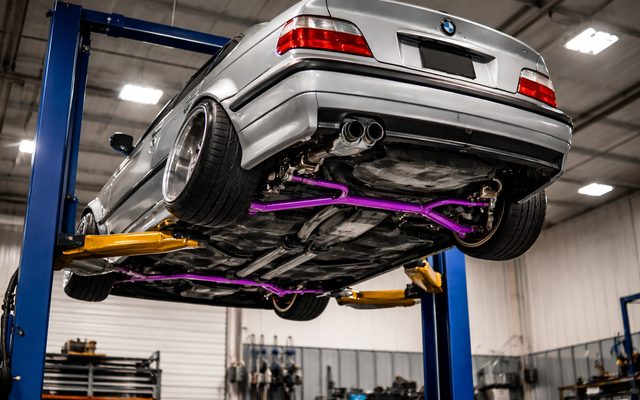
The foundation of any great drift machine is, without question, the chassis itself. A select group of platforms have attained renowned reputation within the global oversteer community due to their inherent balance, robust build quality, and the immense range of performance components available. Picking the optimal car is the primary and most significant decision a builder will make. For instance, the BMW's E36 3 Series is commonly accepted as among the finest all-around drift platforms of history. Its almost ideal balanced front-to-rear weight, alongside a RWD layout and bulletproof six-cylinder engines, creates a platform that is at once accessible for beginners and incredibly competitive in the hands of a professional competitor. The next step of this philosophy, the BMW E46 platform, refines these qualities with a increasingly sophisticated frame, increased wheel track for enhanced confidence, and even a greater degree of steering angle as standard from the OEM. Another dominant platform in the top-level arena is the Chevrolet Corvette C6.
This V8-powered track weapon brings a unique array of benefits to the sideways sport, including a light aluminium chassis, a transaxle-style drivetrain component that contributes to an excellent front-to-rear mass ratio, and the colossal thrust of a large-displacement LS-series V8 engine. This blend renders it an utter monster on track, able of starting and maintaining long drifts with seemingly minimal deployment of acceleration. For builders looking for outstanding bang-for-the-buck, the Nissan Z33 rises above as a prime choice. It arrives from the manufacturer with a rigid body structure, a competent original locking differential, and the free-revving VQ35DE powerplant that delivers plenty of horsepower and torque for learning and moving up in the activity. Its successor, the Nissan Z34, presents more improvements in chassis stiffness, suspension design, and peak motor output, establishing its position as a favorite selection among professional drivers. Further iconic vehicles that deserve mention include the lightweight rotary-powered Mazda FC RX-7, the ubiquitous Nissan S13, the torque-rich Ford SN95, the modern BMW E90, and the compact yet incredibly engaging and forgiving Mazda MX-5. All of these platforms provides a unique set of traits, difficulties, and capabilities, but they all share the fundamental ingredients necessary to become a serious sliding vehicle.
However, selecting the optimal platform is only the first step. To unlock the complete capability of every of these cars, major upgrades to the steering and chassis control systems are completely mandatory. This is where the realm of precision drift-spec components comes into vital view. The single most impactful modification for a dedicated competition vehicle is the integration of a drift-spec drift angle kit. These engineered systems, such as those manufactured by specialist companies like SLR, are created to significantly expand the chassis's possible steering angle. A standard street car is severely restricted in how far its steering tires can pivot, a safety trade-off for daily operation. In sliding, conversely, maximum opposite lock is frequently needed to catch and maintain a angle. An modification kit exchanges the factory uprights, tie rods, and sometimes control arms with components that permit the wheels to achieve steering lock over 70 or even 80 °, versus a average stock setting of around 40 to 50 °.
This immensely increased lock provides the operator with dramatically enhanced command during a angle, enabling it to be far simpler to initiate a slide, hold it through a sweeping turn, and transition fluidly from one direction to the other. The contrast in drivability is truly transformative. Paired with a correctly selected steering kit is the equally essential enhancement to the car's spring and damper setup. Store-bought or including high-end road dampers are just not intended for the unique and harsh needs of sliding. A drift-spec set of adjustable dampers is of utmost importance. These specialized dampers have custom piston tuning and spring rates that are tuned for the extreme weight transfer that is inherent of aggressive driving. When a operator initiates a slide, the chassis's inertia is thrown rapidly to the front of the bend. Proper competition dampers handle this transfer in a predictable way, permitting the vehicle to settle quickly and providing the operator clear feel through the wheel and cockpit. They furthermore allow for precise tuning of stance, shock absorber rate, and corner weighting, which are all key elements of fine-tuning the car's dynamics to a specific track or competition style. In combination, a precision-engineered angle modification system and a properly chosen set of competition suspension units are the core hardware foundation upon which all subsequent optimization is based.
Once the core hardware is installed, the next essential step in the development is the detailed adjustment of the vehicle's suspension geometry. This is the domain of chassis dynamics adjustment, a process that can seem intimidating to the newcomer but is, in practice, the defining factor to transforming a collection of fast parts into a cohesive and predictable whole. The most discussed aspect of alignment for drifting is undoubtedly camber. Camber is the inclination of the wheel compared to the perfectly straight line when looked at from the front-on of the car. When the top of the tire is angled towards the car, this is known as negative camber. For oversteer driving, inward-leaning wheels on the front axle wheels is widely applied and is regarded as essential. The purpose is deeply tied to physics.
When a vehicle is going around a bend at high angles, the frame leans towards the outside of the bend. This chassis roll causes the outer steering tire to lose its best footprint with the tarmac. By adding negative camber, the wheel is pre-angled to compensate for this tilt. As the vehicle tilts into the turn, the tire flattens out on the road surface, optimizing its traction at the critical time when it is needed most for directional command. Usually, front axle angles for a competition drift machine fall between approximately -3 degrees to as extreme as -5 degrees or even beyond, based on the parameters of the car geometry, tire type, and driver style. The back wheels also employ inward tilt, but the values are typically more conservative and more nuanced than the front axle. Excessive inward lean at the back can cause the vehicle to extremely tail-happy and hard to control on throttle input, as it reduces the usable contact patch of the driven wheels during forward throttle application. Thus, rear axle camber settings are commonly in the range of -1 degree to -3 degrees, finding a delicate compromise between giving enough lateral grip to assist in initiating and maintaining the slide while simultaneously maintaining usable traction for acceleration the corner. camber angle is merely one element of the broader tuning equation, which car alignment tuning furthermore includes toe angle, self-centering steering, and suspension tuning tool steer correction modification.
Toe describes the orientation of the wheels as seen from a bird's-eye view. Toe-in means the front edges of the tires are nearer together than the trailing edges, while outward toe means the converse. For oversteer, a small amount of front toe out is commonly used to sharpen the turn-in directional response, making the car feel more nimble and willing to start a drift. Rear axle toe angle is generally set to neutral or a very slight amount of toe-in to promote stability under acceleration. caster angle is the frontwards or backwards angle of the kingpin axis when looked at from the side-on of the car. Increased positive caster improves feedback and high-velocity confidence, and it additionally increases negative camber gain during cornering, which is highly useful. Setting these values is a detailed interaction where a adjustment to a single parameter can and will influence the remaining parameters. The conventional approach for tuning a car's alignment for competition has historically been a time-consuming affair of guesswork and adjustment. A pilot or team would introduce a modification based on intuition, test the vehicle on track, rely on the driver's individual sensation and comments, and then make another tweak. This process would continue again and again until the car felt "good" or the scheduled practice period was exhausted. This methodology is not only exceptionally wasteful in terms of man-hours and costs, but it is also inherently inaccurate.
Pilot perception is a notoriously unreliable measurement tool, colored by countless factors such as exhaustion, evolving track surfaces, temperature, and merely the mindset of the driver on that given session. What feels "oversteery" on one run might feel "tight" on the subsequent run, leading to contradictory information and frustrating changes. This age-old problem in car suspension tuning is exactly where modern engineering tools has stepped in to completely change the process.
The rise and integration of sophisticated drift telemetry software has brought about a new age for building and refining professional drift cars. This new generation of platforms, exemplified by cutting-edge products like modern telemetry hardware, work by directly capturing the actual physical movement of the chassis as it is being driven on the circuit. As opposed to relying on subjective impression, these devices gather measurable information on key variables such as damper compression and extension, wheel speed, G-force loading, lock position, and throttle and brake position. This acquired information flow is then processed by powerful software that can graph and interpret the data in a comprehensible format. For the first time, tuners and teams can see exactly what the vehicle is performing at every moment of a lap. This ability revolutionizes the entire suspension tuning process. Consider the specific challenge of dialing in the front camber for a specific car. Rather than making a adjustment from -3 degrees to -3.5 degrees and then driving many passes to try and "perceive" a improvement, a suspension tuning tool can provide immediate and irrefutable information. The tool can indicate in a chart how the suspension's loading is performing during the critical stages of a slide: turn-in, mid-corner, and transition. It can reveal if the current camber setting is allowing the outside front tire to keep maximum grip or if the rubber is over-stressed on its outside edge.
The system can after analysis provide fact-based advice for modification. Perhaps the telemetry indicates that the outside front tire is still overloading its edge at -3.5 degrees of negative camber, indicating that an increase to negative camber, say -4 degrees, might be warranted. Alternatively, the data might indicate that the tire is failing to achieving heat or that the inner shoulder is degrading excessively, which could suggest that there is overly aggressive negative camber and a small reduction back to -3.2 degrees would be more optimal. This degree of accuracy and useful intelligence was completely impossible in the days of solely mechanical setup.
The benefit of using a advanced vehicle dynamics tool reaches well beyond merely setting camber angles. It functions as an priceless coilover setup tips that is specific to your specific chassis. When fine-tuning the damping values on your coilovers, rather than relying on general advice or replicating another driver's settings, you can use the data to see how the car is behaving in relation to your tweaks. The tool can graph the damper movement data over a lap, showing if the dampers are managing the chassis motion properly or if they are causing the car to oscillate uncontrollably after a direction change. It can aid in diagnosing problems like excessive compression or losing droop, permitting you to make educated adjustments to spring preload, damping settings, or stance. This process translates similarly to the complex process of corner balancing. In addition to camber, the tool can give analysis into how changes to toe and caster angle are influencing the vehicle's stability during various phases of a lap. For instance, it can help you to determine the ideal amount of front axle negative toe for your specific steering configuration and piloting approach by showing the speed of initial response and the stability of the car at maximum countersteer. This transforms the software an incredibly powerful vehicle dynamics manual that is actively informed by the real-world dynamics of your specific chassis on the tarmac. It elevates the complete project from a dark art into a repeatable engineering exercise.
Furthermore, the utility of a system like GripDial is not limited to experienced teams with extensive funding. For the club-level competitor, it functions as an powerful educational tool. It practically gives the driver with the knowledge of a professional dynamics engineer without the associated cost. It drastically shortens the tuning process by delivering unambiguous solutions to problems that would otherwise take seasons of experimentation to solve. A builder can understand how their specific vehicle behaves to various adjustments, building a more intuitive knowledge of car control in the endeavor. It also opens up advanced chassis dynamics concepts, permitting every enthusiast with the desire to refine their machine to achieve it in a structured and successful way. This is particularly significant in a discipline like sliding, where engineering expertise has traditionally been a closely guarded advantage among top crews. Today, that knowledge can be in the toolkit of any motivated driver.
In conclusion, the process to engineering and optimizing the perfect competitive sliding vehicle is a multi-stage mission that perfectly combines time-honored mechanical wisdom with cutting-edge data technology. It starts with the strategic choice of a proven platform, followed by the integration of critical drift-spec parts like high-performance drift angle kits and correctly selected competition suspension units. The process then progresses into the detailed phase of chassis dynamics adjustment, where settings like negative camber, toe, and caster are precisely adjusted to suit the vehicle's modified hardware and the driver's individual needs. Finally, and what genuinely differentiates the modern methodology from the traditional methods, is the use of a sophisticated vehicle dynamics tool. This platform eliminates the uncertainty and trial and error of only subjective setup by giving empirical, real-time telemetry on car alignment tuning how the car is really functioning. It acts as an unparalleled diagnostic aid, a actionable drift suspension tuning guide, and a comprehensive performance analyzer. As a complete package, this complete methodology ensures that every element of the drift machine—from the pick of the car to the most minute tweak on the damper—is optimized for maximum performance on the track. It signifies the complete maturation of the discipline of sliding, merging physical pilot talent with data-informed vehicle setup to forge the perfect dominant vehicles attainable.